
Musculoskeletal Disorders
Stem Cell Therapy for Herniated Disc
Regenerative approach to disc-related pain and nerve compression.
What Is a Herniated Disc Injury?
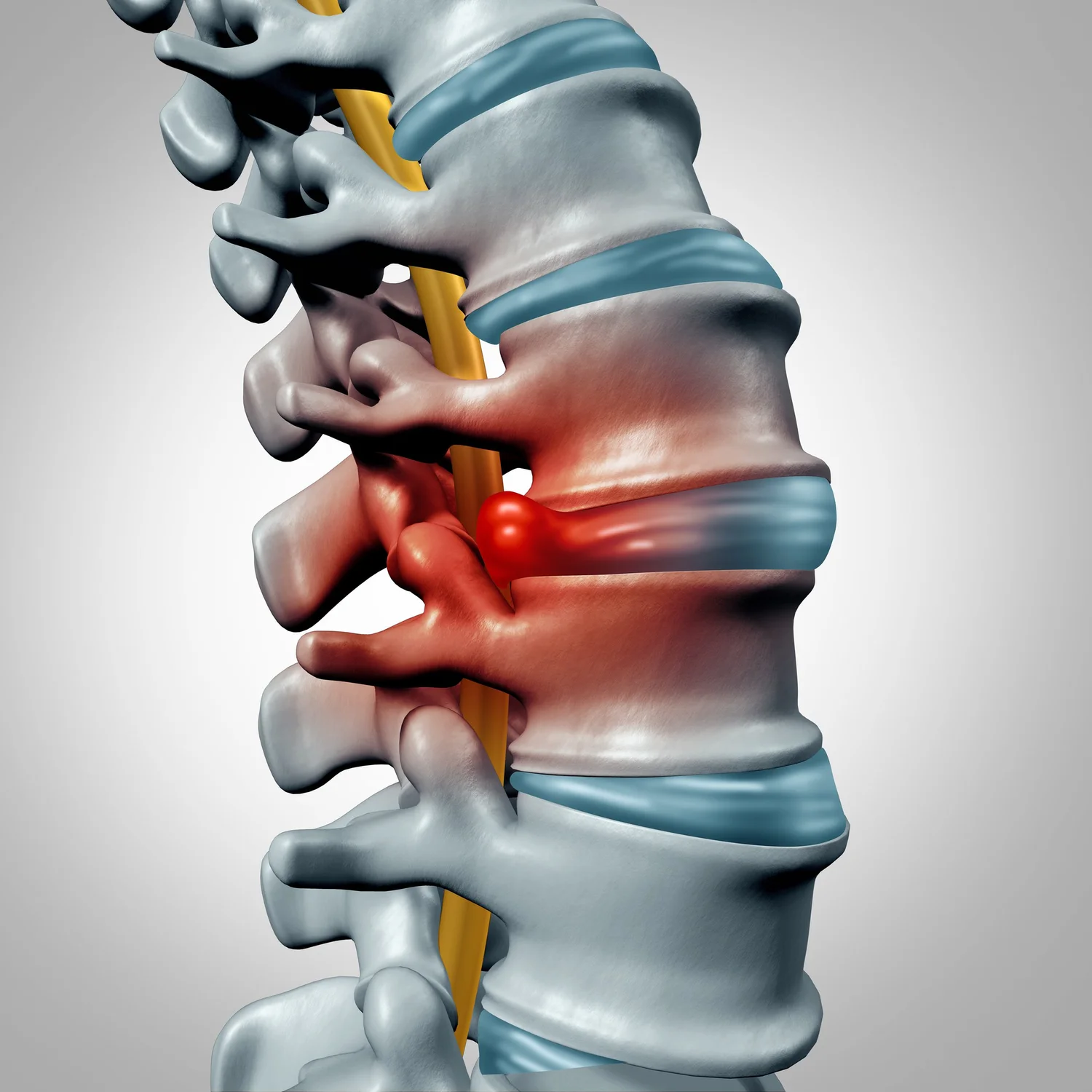
A Herniated Disc, also known as a slipped disc, occurs when a disk in the spine moves out of place or breaks open and puts pressure on nearby nerves or the spinal cord. This can happen due to injury or strain, and it's one of the most common causes of lower back pain.
What Causes of Herniated Disc Injuries?
HDI can be caused by a number of factors, including:
Weight: Being overweight puts extra stress on the lower back's discs.
Occupation: People with physically demanding jobs may be more likely to experience back problems.
Genetics: Some people may be predisposed to developing a herniated disc.
Smoking: Smoking may reduce the amount of oxygen available to the discs, causing them to break down more quickly. Smoking also exposes the body to carbon monoxide, which can prevent the discs from absorbing nutrients from the blood. Without proper nutrients, the discs can dry out and become less flexible, increasing the risk of herniation.
Frequent driving: Sitting for long periods of time while driving, combined with the vibrations from the engine, can put pressure on the spine.
Sedentary lifestyle: A lack of regular exercise can increase the risk of a herniated disc.
Age: Herniated discs are more common in middle-aged and older men.
Lifting heavy objects: Using the back muscles instead of the legs to lift heavy objects can cause a herniated disc.
Repetitive activities: Repetitive bending, twisting, or flexion of the lower back can strain the spine and increase the risk of a herniated disc.
A herniated disc occurs when the gel-like center of a disc pushes through a crack in the firmer outer layer. The leaked material can press on nearby spinal nerves, causing symptoms such as pain, numbness, tingling, or muscle weakness. Symptoms may differ depending on the location of the herniated disc. For example, pain in the lower back may affect the buttocks, thighs, and calves, while pain in the neck may be more likely to be felt in the shoulders and arms.
What are the symptoms of a Herniated Disc?
Symptoms of a herniated disc can vary depending on the location of the injury. A herniated disc occurs when the outer layer of a spinal disc tears or punctures. The disc contains a soft, jelly-like center and an outer band.
Here are some common symptoms of a herniated disc in the lower back:
Pain
Pain in the lower back, buttocks, thigh, calf, or foot. The pain may be sharp, burning, or shooting. It may feel worse when standing or sitting, at night, or when bending backward or walking. It may also worsen with movement, such as when sneezing or coughing.
Other symptoms
Numbness in the leg or foot, muscle weakness in the legs, decreased reflexes at the knee or ankle, and changes in bladder or bowel function.
Here are some common symptoms of a herniated disc in the neck:
Pain: Pain when moving the neck, deep pain near or over the shoulder blade, or pain that moves to the upper arm, forearm, and fingers. The pain may shoot into your arm or leg when you cough, sneeze, or move into certain positions.
Other symptoms: Numbness along the shoulder, elbow, forearm, and fingers.
You can try a simple test to determine if you have a herniated disc. Lie on your back with your knees bent and feet flat on the floor. Place one hand behind your head and gently tilt your head to the opposite side. If you feel pain in your neck, it may be indicative of a herniated disc.
How are the Herniated Conditions treated?
Discs cushion the vertebrae that make up the spine in the back. They act as a shock absorber in the spinal column situated between each spinal vertebrae. A Herniated Disc is also known as a bulged, slipped, or punctured disc. Disc herniation occurs when a tear or rupture in the annulus forces a nucleus fragment out of the annulus and into the spinal canal. When a herniated fragment goes to the spinal canal, it can push onto the spinal nerves and produce severe pain symptoms in the relative spinal nerves. It can affect any part of the entire spine, but the most common areas affected by the Herniated Disc are the lumbar and cervical spine.
Treatment options for a herniated disc can be divided into non-surgical and surgical treatments.
Non-surgical treatment
Physical therapy
Electrotherapy
Non-steroidal anti-inflammatory medications
Steroid Injections
Surgical treatment
Laminotomy
Discectomy
What Is Stem Cell Therapy?
Stem cell therapy offers promising treatment options for herniated discs. By introducing advanced stem cells, this therapy promotes the regeneration of damaged tissues, potentially reducing pain and improving mobility. Stem cells release various growth factors and cell regulators that aid in the healing process, offering a non-pharmacologic alternative to traditional treatments. This innovative approach not only enhances patient satisfaction but also lowers healthcare costs by reducing the need for repeated drug administration.
Treatment of Herniated Discs
Stem cell therapy can treat herniated discs by injecting the patient's stem cells directly into the disc to regenerate damaged tissue. The stem cells can differentiate into bone, cartilage, or fat cells to stimulate healing. This can help relieve pain, reduce inflammation, and rebuild the disc material.
Stem cell therapy is a minimally-invasive outpatient procedure that uses image-guided techniques like X-ray fluoroscopy and ultrasound to deliver the stem cells. The stem cells can be extracted from the patient's bone marrow using a needle and centrifuge, so the body won't reject them.
Stem cell therapy can also be combined with platelets to regenerate the surrounding tendons and ligaments. Some say that patients can typically return to their normal activities within a few days of receiving the injections and see significant symptom improvement over a few months.
These treatment options aim to alleviate pain, restore function, and improve the quality of life for individuals with herniated discs.
Herniated Disc Immune Response Issues
Research in stem cell therapy holds promise for developing non-pharmacological treatment alternatives for Herniated Disc pain. While these therapies may reduce the need for frequent medication, they do not eliminate it entirely. Mesenchymal Stem Cells (MSCs), known for their immunomodulatory properties, have shown potential in various studies. However, there have been reports of immune-mediated damage to stem cells after their insertion and differentiation.
Sources and Application of Stem Cells
Stem cells can be extracted from various sources, including muscles, bones, bone marrow, and adipose tissue. The two most frequently used sources in stem cell therapy are adipose tissue and bone marrow. Bone marrow is collected using a needle and then centrifuged to separate growth factors and stem cells. These stem cells are carefully injected into the herniated disc. Upon activation at the site of damage, they replace old, damaged cells with new, healthy ones, thereby improving pain and inflammation.
Stem cell therapy offers a promising avenue for treating musculoskeletal injuries, providing long-term benefits and enhancing patient outcomes by leveraging the body's natural healing processes.
Role of Exosomes in Stem Cell Therapy
Stem cell therapy, enhanced by exosomes, offers a promising approach to treating musculoskeletal disorders. Exosomes play a crucial role in preventing and managing the progression of various diseases through microRNAs (miRNAs). For instance, silencing miRNA-101 via exosomes can prevent cartilage degradation in arthritis, addressing one of the most common outcomes of Herniated Disc disorders.
Benefits of MSC-Exosome Therapy
MSC-exosome therapy has demonstrated significant benefits, including the promotion of osteoclast differentiation and the proliferation of bone-forming cells. Research indicates that exosomes can protect against acute tubular injuries. They mediate cell interactions and stimulate cell proliferation, helping to control several diseases and traumas. Exosomes directly transfer microRNAs to affect signal transduction pathways in targeted cells, making them a valuable tool in microRNA cell therapy for age-related Herniated Disc diseases and disorders.
Summary
Exosome-enhanced stem cell therapy offers effective solutions for managing musculoskeletal disorders, highlighting its potential to advance medical treatments and improve patient outcomes.
How is the treatment at The Renue Medical Centre different?
Stem Cell Therapy (SCT) at The Renue Centre is a holistic approach to treating Musculoskeletal Problems.
Your Renue Journey treatment for Herniated Disc Repair with Stem Cells consists of four phases:
Pre-treatment: You will take our Renue Epigenetic Test powered by TruDiagnostics that will assert your biological age and other important health markers. Your TruDiagnostics test is part of The Renue Difference. It provides your doctor with critical information about your health and your true age (biological vs. chronological). After the epigenetic test and we have received all your medical records, your Patient Advisor will assist you in planning your travel to Puerto Vallarta.
Treatment day: On the treatment day, a total of 144 million umbilical cord-mesenchymal stem cells are inserted in the two sittings through the IV route.
30, 60 & 90 days follow-up: To check for flare-up frequency, improvements, pain, and irritation.
Six months after treatment: Lab tests, flare-up frequency, clinical evaluation, mobility, quality of life, and prognosis.
Expected results: benefits and outcomes
SCT to live a better life: Benefits and outcomes
The effectiveness of Stem Cell Treatment can improve all your symptoms, causing a considerable impact on your quality of life and daily activities.
As part of The Renue Difference, you will receive three Hyperbaric Chamber sessions that greatly improve SCT efficacy and stimulate the body cells to treat MSIs in Herniated Discs. These sessions comprise three days: one day before treatment, after treatment, and on the day of treatment.
According to results, clinical outcomes, and pre and post-treatment observations, SCT has been shown to help
Reduce MSIs progression
Speed up tissue repair
Regrow and repair tissues after six months
After the SCT procedure, an MRI test depicts the further need for the treatment at a specific body site.
Talk to our Patient Advisor to learn more about SCT at The Renue Centre.
Expected results and prognosis:
The outcomes of Stem Cell Treatment for Herniated Disc are quite positive. The Stem Cell Therapy prognosis can be checked in three phases:
Prognosis 1: Within the first week of therapy, there was instant pain reduction.
Prognosis 2: With stem cell treatment, the patient's mobility of the afflicted foot will begin to improve in the next three months, and discomfort associated with movement will be much reduced.
Prognosis 3: Cellular mobilization, proliferation, and regeneration of new cells. Tissue strengthening and resistance to recurrence of injuries and illnesses. After six months of injection, there will be more independence in activities of daily living, as well as mobility.
What are the risk factors of Stem Cell Therapy for Herniated Disc and conditions?
he risks of Stem Cell Treatment are dependent on a variety of factors. Risk is calculated as the measure of the possibility of damage occurring and the degree of that loss.
Some of the frequently observed risk factors are:
Type of cells used
Cell culture history
Location of injection
Manipulation level of stem cells
Management of Risks
The majority of the negative consequences and side effects of Stem Cell Therapy can be controlled and managed effectively. We can prevent harmful consequences with proper selection of the cell type and detailed history of the process they underwent earlier. Preparing the patient and site of injection with care can help to limit post-treatment infections.
Stem Cell Therapy has a great potential to be more effective for treating Musculoskeletal Injuries than previous methods and carries less risk. SCT has a great potential to emerge as one solution to all the human body problems, but it will need some time and patience.
All the treatment options for Musculoskeletal Injuries have been temporary options for just treating the symptoms. With the invention of Stem Cells Replacement Therapy, hopes and prognosis of the disease treatment have been raised. It has the potential to be more effective than previous methods and also carries less risk.
This page is for general information and does not constitute medical advice. All treatment plans at Renue are individualized following a physician review. See Research Articles for supporting literature.
Ask About Herniated Disc
Why Patients Choose Renue
Advanced Cellular Laboratory
On-site cellular manufacturing with rigorous quality control.
World-Class Physicians
Experienced physicians dedicated exclusively to regenerative medicine.
Hyperbaric Oxygen Center
One of the few clinics integrating HBOT into comprehensive protocols.
Personalized Treatment Plans
Every patient receives an individualized treatment strategy based on their condition and goals.
Concierge Medical Experience
Airport transportation, hotel coordination, and dedicated patient support throughout your stay.
Long-Term Follow-Up
Our relationship continues well beyond your visit with structured physician follow-up.
Get started
Book a Consultation
Your journey to a better quality of life starts here. One of our advisors will get back to you shortly.